


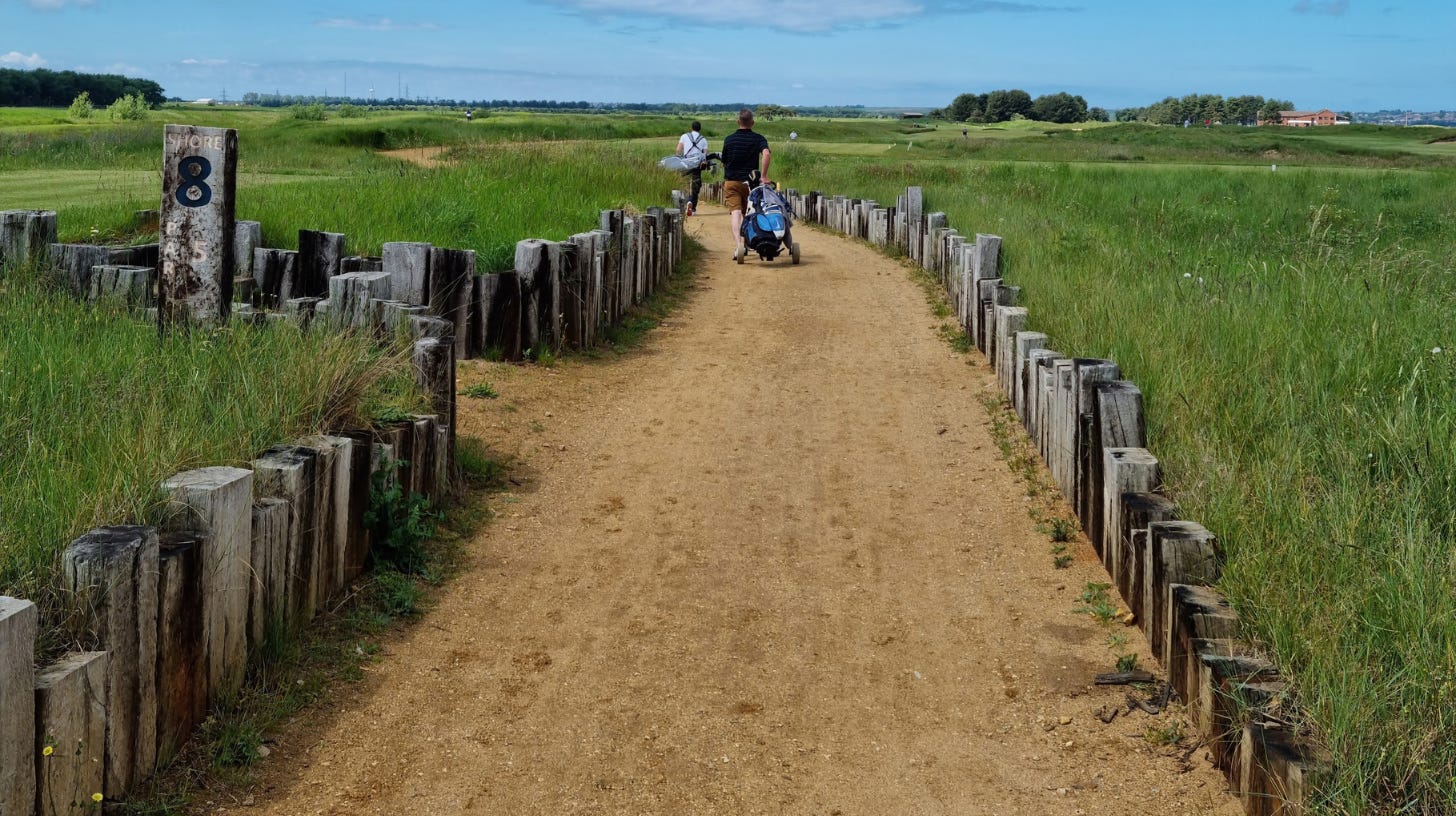
I’ll be upfront. I get to play more golf than most people. My schedule’s flexible and my kids are older now. And I still want more.
But it wasn’t always like that. There were Saturdays when the kids had football, and 18 holes just didn’t fit. Or the fence in the garden needed fixing. So it was nine holes or nothing. And nine won every time.
Right now, with the afternoons getting shorter, I’m reaching for nine again. And autumn’s one of my favourite times to play. The courses look unreal.
So when we asked you what stops you playing more, I wasn’t surprised by the answer.
Why don’t we play as much golf as we want?
Time. That’s the big one.
Think about what a round really costs you. Four hours on the course. The drive there and back. A drink after, because it’d be rude not to. That’s your Saturday gone. And most weekends, something else has already claimed it.
So golf goes on the “next weekend” list. And stays there.
We asked you about it on our Instagram Stories, and 64% said time is the main thing stopping you. Small poll, I know. But a Golfshake survey of 1,200 golfers found the same thing: lack of time was “comfortably the most cited reason”.
So it’s not that people have gone off golf. They just can’t find the day.
Isn’t nine holes just half a round?
No. And this is the bit that gets me.
Golf has changed loads in the last few years. Simulators, gamified driving ranges, Topgolf, and many other new formats. (I wrote about how off-course golf has even become a first date in The Icebreaker.) But on the course itself, most of us still picture 18 holes as the “proper” round. Nine feels like a warm-up. Or what you do when you’ve run out of daylight.
I think that’s wrong. Nine holes is the same course, the same first tee nerves, the same tree you always hit. Just in half the time. It even counts for your handicap now, same as 18. And if the word handicap puts you off, The Misread is for you.
And quite a few people seem to have worked that out already. In England, nine-hole rounds put in for a handicap went up 28% last year.
It’s not half a round. It’s a round.
What can you do with nine holes?
This is where I think nine gets really interesting. Because it’s not just a shorter version of the same thing. It changes what the round is for.
It can be quick. If the course isn’t busy, you can get round fast. One of our community members, Wull (@je_suiswilliam), put it better than I could:
“My golf nowadays is for social, and meeting with my father, father-in-law and many friends. 9 holes is great. If there’s not much traffic, you can fire round in an hour.”
He also told us he’ll take a half set in a pencil bag and leave the driver at home. Which is exactly the point. Nine holes doesn’t need the full kit, the full day or the full seriousness.
So here’s what I think nine holes is good for:
A catch-up. A couple of hours with friends or family, walk and talk. Less about the score, more about the chat.
A meeting. Same idea, different company. Walk, talk, and you’ve done business without a meeting room.
A proper game. It counts for your handicap now, so you can still play for something.
Practice. If the course is quiet and you’re on your own, you can work on the shots you struggle with, on a real course, not a range.
Learning. If you’re new to the game, or new to a course, nine holes is the easiest way to get to know it.
That last one matters more than people think.
Why is nine holes the best way in for a beginner?
Because the first full round is scary. I remember it.
You’re worried about holding people up. Worried about not knowing the rules nobody tells you. Worried that everyone’s watching. Four hours of that feeling is a lot to ask of anyone. Nine holes halves it.
Some clubs are getting clever with it too. We covered a day at Alderley Edge Golf Club in Cheshire called Golf and a Giggle. Golfers were paired with total beginners. In the club’s words, “the Golfer plays to the green, the Non-Golfer makes the putts.” Then on hole six they swapped, with the beginners teeing off a bit closer. Nine holes, one shared score, a curry and a drink after.
That’s how you take the fear out of a first round. The beginner isn’t holding anyone up. They’re half the team.
Why isn’t anyone selling nine holes?
This is my main point. Nine holes fixes the biggest reason people don’t play more. And it’s one of the best ways in for someone new. But you’d hardly know it.
From what I’ve seen, nine holes is usually the thing tucked away on the booking page, or the late slot nobody talks about. It’s treated like the B-side. Not the single.
And I’m not the only one who thinks it deserves more. Earlier this year, Golf Monthly’s Baz Plummer made the case for nine-hole competitions every weekend. With a young family, he wrote, he “often can’t justify ‘popping out’ to the golf club for four hours every weekend.” Sound familiar?
So what would I do about it?
Market it. Properly.
Sell nine as its own thing. Not “the short option” hidden at the bottom of the page. The main event for anyone who’s busy.
Put it front and centre on booking pages. Give it a name. Then make a night of it. Nine holes, a drink and a meal after. That’s an evening out, not a compromise. I’d book that every week.
And mix up the format. Do what Alderley Edge did and pair golfers with beginners. The golfer gets it to the green, the beginner putts. Suddenly nine holes isn’t just for the busy. It’s the easiest way to bring a friend into the game.
And for those of us who already play, stop treating it like a lesser round. Ask a friend who’s never played to come and do nine with you. Let them putt. See what happens.
The Shortcut
Nobody’s checking whether you played all 18. Golf never said you had to.
So this weekend, if you’ve only got a couple of hours, take them. Nine holes, your friends, a drink after.
What stops you playing more? And have you tried nine instead? Drop a comment.
Previously in Room 19:
Issue 016 | The Understudy, on why golf commentary needs human energy, not an AI with more stats.
Issue 015 | The Heads Up, on why golfers shout fore when it isn’t a rule.
Issue 014 | The Icebreaker, on why off-course golf is becoming a faster, more honest way to get to know someone.
Issue 012 | The Misread, on the handicap system most people mistake for a scale of shame.
I started Room 19 because I wanted golf writing that treated the game the way the culture magazines I read treat everything else, properly, not as tips, gear reviews and FOMO shots of golf courses. If you want the next one first, subscribe below.
Paul is the founding editor of Room 19, a golf brand telling the untold stories of the game for people who found it through culture, not the clubhouse. He took up golf at 37.
Find Room 19 on Instagram and TikTok.
Quick answers
Why don’t people play more golf? Time is the most common reason. A Golfshake survey of 1,200 golfers found lack of time was the most cited reason. In a small Room 19 Instagram poll, 7 of 11 (64%) said time was the main thing stopping them.
How long does nine holes of golf take? Usually around an hour and a half, and quicker on a quiet course. An 18-hole round in a four-ball takes a minimum of about four hours.
Do nine-hole rounds count towards your handicap? Yes. Under the World Handicap System, a completed nine-hole round can be submitted and counts towards your Handicap Index, including in England.
Is nine-hole golf growing? Yes. In England, nine-hole scores submitted for handicap rose 28% in 2025.
Is nine holes good for beginners? Room 19’s view is yes. It’s shorter, lower pressure and an easier way to learn a course.
What is a pairs format for beginners? One example is Golf and a Giggle at Alderley Edge Golf Club, where an experienced golfer plays to the green and a beginner putts, sharing one score.
Sources and numbers
Time is the main barrier. 7 of the 11 Room 19 readers who answered our Instagram Story poll (64%) said time is the main reason they don’t play golf more often (29 September 2026).
Lack of time is the most cited reason golfers don’t play more, in a Golfshake survey of 1,200 golfers (June 2025).
Younger golfers miss out most. In the same survey, 38% of golfers under 55 played as much golf as they wanted, against 57% of 55 to 64s and 75% of over-65s.
18 holes takes about four hours. Golfshake puts a four-ball round at “a minimum of four hours”, not counting travel.
Most golfers want more. 59% of recreational golfers in England want to play more regularly, per England Golf research (July 2026).
Nine-hole golf is growing in England. Nine-hole scores submitted for handicap rose 28% in 2025, in a record year of 11.83 million total scores, per England Golf (January 2026).
And in the US. Nine-hole rounds made up 18.2% of all scores posted in 2025, up from 13.7% in 2020, per USGA data via MyGolfSpy (February 2026).
New golfers lean towards nine. In the US, over half of first-time female golfers’ scores and around 27% of first-time male golfers’ scores were nine-hole rounds (same USGA data).
Nine holes counts for your handicap. Under the World Handicap System, a completed nine-hole round converts to an 18-hole score using an “expected score”. The R&A made the change because “golfers across the world are playing more 9-hole rounds” (The R&A, England Golf).
A nine-hole round takes around an hour and a half on average, per MyGolfSpy.
Beginners don’t always feel welcome. Only about 36% of US non-golfers say they’d feel comfortable around other golfers, and about half question whether they’d feel welcome at a course, per the National Golf Foundation (April 2026).
Golf and a Giggle pairs format at Alderley Edge Golf Club, Cheshire, from the club’s own event listing (September 2026).
Baz Plummer, “Why I’m Campaigning For 9-Hole Competitions (Every Weekend)”, Golf Monthly (April 2026).
Wull’s quote is from a Room 19 community member, used with permission. The opening, the views on what nine holes is good for, and the ideas on marketing it are Paul’s own.