


By Paul, Founding Editor, 20 Handicap
Issue 012 | The Misread
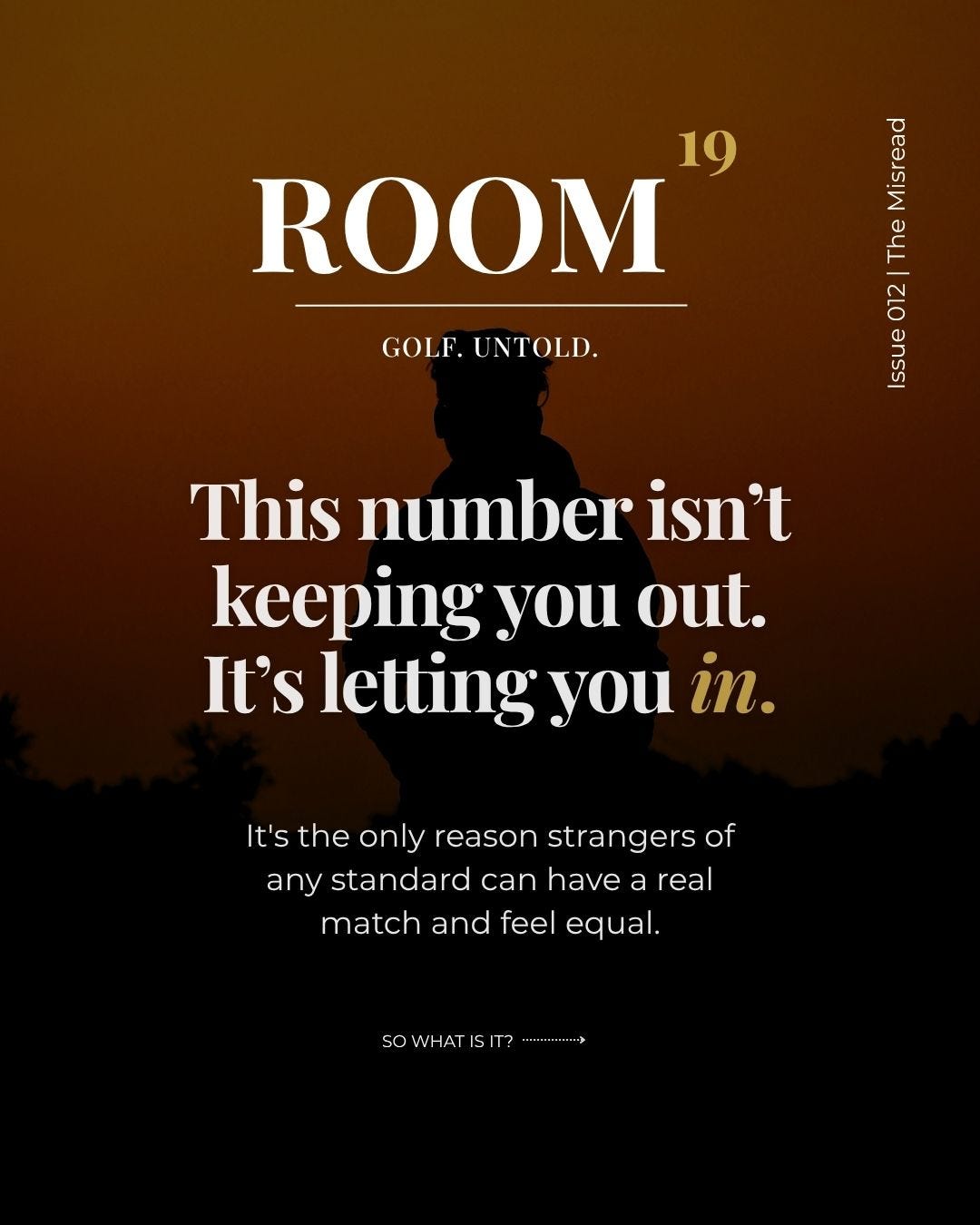
Golf treats a high handicap like a confession, a number to lower before anyone sees it. It’s the reason two strangers of wildly different ability can play each other and call it a fair match. More than 780,000 golfers in England carry one, and more than 6 in 10 of them play off 16 or higher, nowhere near the standard most beginners assume they’d be up against. Even St Andrews’ Old Course and Royal Troon, two of the most exclusive-looking addresses in the sport, only ask visitors to be roughly average, 24 or under and 20 or under respectively, not elite. The number was never testing whether you belong. It’s the reason you already do.
None of this changed how I thought about golf because of a stat. It changed on an ordinary Saturday, in a pub, listening to my mates tell me how well they’d played, how they’d won, before I’d ever picked up a club myself.
I finally started playing with them properly, and saw behind the curtain. Their handicap did the winning, not their golf. Their game on the course wasn’t especially standout, it just matched a system built to let two different standards compete and still call it fair. Finding out the story I’d been told wasn’t quite true should have felt like a letdown. Instead it did the opposite. It’s what let me stand on a tee with players better than me and not feel like I was intruding on their game.
The other assumption took longer to correct. I assumed there’d be certain courses I simply wouldn’t be let onto without a low enough number attached to my name, an Open Championship venue being the obvious example. Then I played Prince’s Golf Club in Sandwich, Kent, an Open venue since 1932, and nobody asked me for a handicap certificate at any point. Golf’s most exclusive-looking rooms turned out to have a wider door than I’d assumed.
Is the golfer you’re afraid of as good as you think?
Mostly, no. More than 780,000 golfers in England carry an official handicap index, and more than 6 in 10 of them play off 16 or higher. The “everyone else” a nervous beginner pictures, low single figures, effortless, unbothered by a bad shot, describes a small minority of the people on the course. Most of the field is a lot closer to average than the fear suggests, which means the stranger you’re paired with on your worst day is probably not judging you the way you assume, they’re most likely in roughly the same boat.
Do the world’s most exclusive courses only let good golfers through the gate?
Not even close. St Andrews’ Old Course, arguably the most famous course on earth, asks visitors for a handicap index of 24 or lower for men (36 for women) to enter its ballot or book in advance. Royal Troon, an Open Championship venue, asks for 20 or lower for men (30 for women). Neither is asking for a scratch golfer. Both are asking for roughly average. If the two most gatekept addresses in the sport only require ordinary, the mental image of golf as a place reserved for the very good doesn’t hold up.
So what is the handicap system really for?
Not a scoreboard of how good you are. Its actual job is closer to a currency exchange rate for ability, it converts two different standards into one fair contest, so a 24 and a scratch golfer can play each other and both have a real match, not a polite mismatch one side was always going to win. Most players never clock this because it works invisibly in the background of every round. The system isn’t rating you. It’s the reason you got invited to play at all.
Why did it take me so long to see this?
Because the misread runs in both directions at once, and both directions point away from the truth. I assumed my number said something about my worth as a player, and I assumed everyone else’s number said something better about theirs. Neither assumption survived getting on the course with people. The bar story and the course-access story are the same mistake wearing two different outfits, taking someone else’s number, or your own, at face value instead of finding out what it’s doing.
Does this change anything if you haven’t started yet?
I think it’s the whole reason to start. Most people decide golf isn’t for them before they’ve even swung a club, based on an idea of the game that the handicap system was specifically built to dismantle. You don’t need to arrive good. You need a number, any number, and the system does the rest, matching you into something fair from your very first competitive round rather than making you wait until you’ve earned the right to compete.
The Misread
Golf didn’t need me to get better before I belonged there. It needed a number that let someone else’s game and mine both count for something, at the same time, on the same course. That’s not a small mechanism. It’s the difference between a sport that waits for you to be ready and one that meets you where you are.
If you’ve ever assumed everyone else on the course was better than you, or that a good course was somewhere you hadn’t earned the right to play yet, I’d like to hear about it. Drop a comment and tell me what your own misread was, and what changed it. PLF
Previously in Room 19:
Issue 009 | The Overexposed, on the gap between the golf everyone posts and the golf everyone plays.
Issue 010 | The Format, on the new shape golf’s growth is starting to take.
Issue 011 | The New Icon, on personality replacing the old template for who gets to stand out.
Personal Story | Golf finally found its voice. Now I want to know who it's speaking to, My first personal editorial post, on golf's YouTube boom and who it's really being built for.
Sources: England Golf’s handicap index figures (780,000+ registered golfers, distribution by handicap band) via National Club Golfer. St Andrews Old Course visitor handicap requirement (24 men / 36 women, for both ballot and advance booking) via Birdie Brae. Royal Troon visitor handicap requirement (20 men / 30 women) via Royal Troon Golf Club’s own visitor information page. Prince’s Golf Club’s 1932 Open Championship history is a matter of public record; the handicap-certificate detail is Paul’s own first-hand account, not a stated club policy.
I started Room 19 because I wanted golf writing that treated the game the way the culture magazines I actually read treat everything else, properly, not as tips, gear reviews and FOMO shots of golf courses. If you want the next one first, subscribe below.
Paul is the founding editor of Room 19, a golf brand telling the untold stories of the game for people who found it through culture, not the clubhouse. He took up golf at 37.
Find Room 19 on Instagram and TikTok.
Quick answers
How many golfers in England have an official handicap? More than 780,000, per England Golf’s own handicap index figures, most of them club members with the rest subscribing through the iGolf app.
What percentage of golfers have a handicap of 16 or higher? More than 6 in 10, meaning the large majority of registered golfers are nowhere near scratch.
What handicap do you need to play the Old Course at St Andrews? 24 or lower for men, 36 or lower for women, required for both the ballot and advance bookings.
What handicap do you need to play Royal Troon? 20 or lower for men, 30 or lower for women. Handicap certificates may be requested on the day.
Do you need a low handicap to play a famous golf course? No. Even the sport’s most exclusive-looking venues generally ask visitors to be roughly average, not elite.