


By Paul, Founding Editor, 19 Handicap
Issue 013 | The Wall
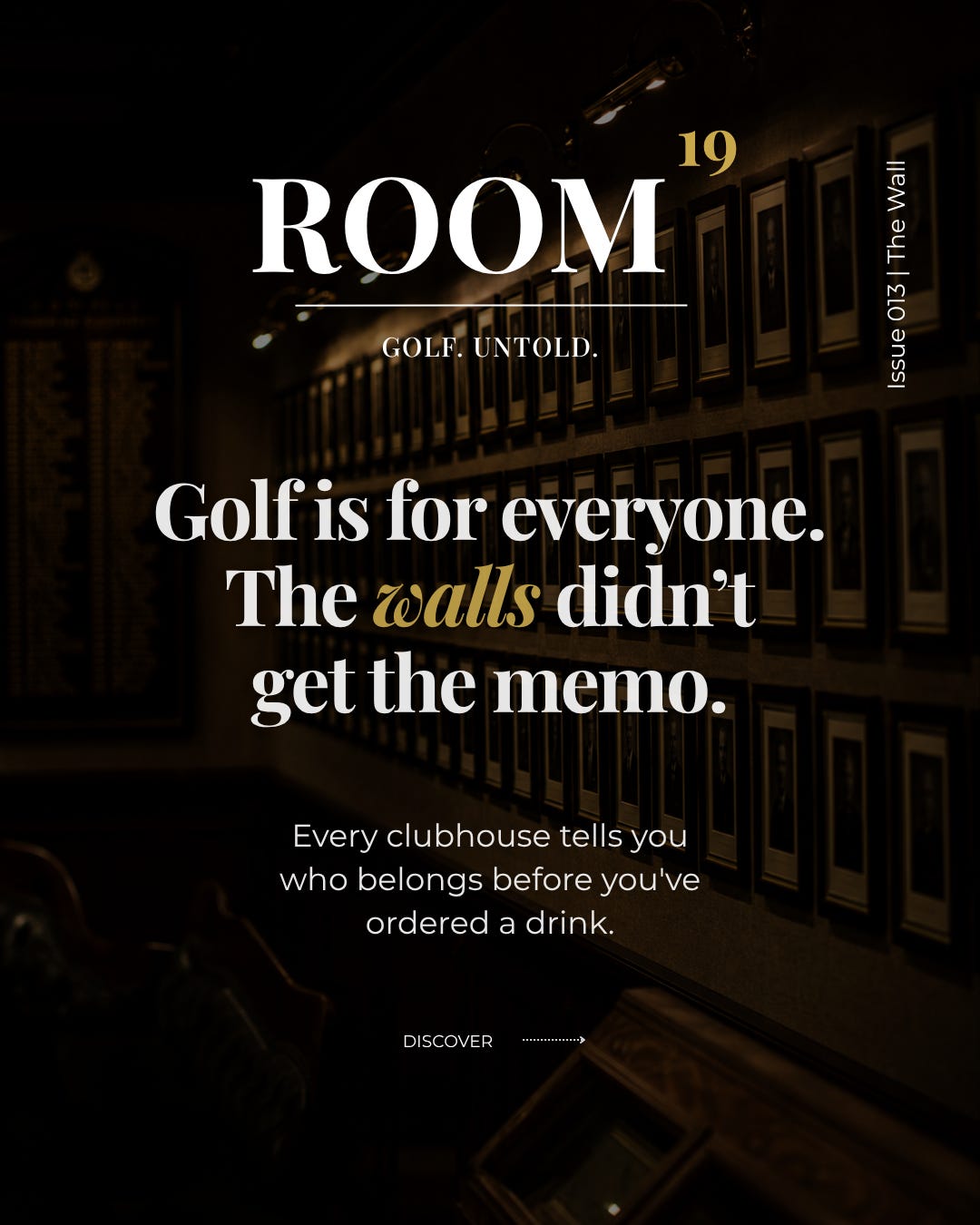
Walking into a golf clubhouse, in my experience, tells you who belongs before anyone’s actually spoken to you. The environment is old and traditional, and that shows up everywhere, portraits of previous winners lining the walls, all with roughly the same look, staff who tend to be picked based on what’s gone before, and a clientele where social class is doing more work than anyone would admit to. None of that is a sign on the door. It’s just what the room looks like, and a room can do all the talking a policy never has to.
I know this isn't only a golf thing, and it isn't only about my own mixed heritage either. It's a feeling I've carried into plenty of rooms outside the game too. Golf just magnifies it. I became a paying member of a club for a year once, and it didn’t make me feel any more welcome. The club already had its people, and wasn’t especially interested in bringing more in. Paying the fee got me through the door. It didn’t get me the feeling the fee was supposed to buy. Belonging.
What shifted it wasn’t a rule change or a new membership policy. It was smaller than that. I waited until I was 37, until one person invited me and made it feel possible, and after that I just turned up without worrying about it. The moments the feeling lifts are usually small too, a more diverse crowd in the room, or a face on the wall that looks something like mine, and I relax without deciding to. That gap, between what changes it and what most clubs assume changes it, is the whole subject of this issue.
What’s deciding who feels welcome in a clubhouse?
The easy assumption is that golf shuts people out on purpose, a policy somewhere, or a person turning you away at the door. That’s rarely how it works. Most of the barrier is unconscious, decided by what a room signals before anyone’s said a word to you. Clubhouses are older, more visual, more tradition-coded than most social spaces, so the evidence is often literally on a wall, whose portrait made the honours board, who’s serving behind the bar, who’s already sitting in the room. None of that needs a rule to work. It just needs repetition.
Does the next generation already look different?
It does, by a meaningful margin. Over 200,000 children have come through the Golf Foundation’s programmes, and 18% of them are from ethnic-minority backgrounds, already ahead of where the adult game sits today. That figure traces back to Golf Foundation CEO Nicola Bennett, reported by Sky Sports in January 2023, so it’s a few years old rather than brand new, worth being upfront about rather than presenting it as this month’s number. Even a few years on, it’s a clear signal that whatever’s changing in junior golf hasn’t caught up with the adult side of the sport yet.
Is there already appetite waiting to be tapped?
There’s a reasonable case for it. One survey, run by Sport Psychology Ltd and the Stephen Lawrence Charitable Trust, found that roughly a quarter of BAME non-golfers said they’d be very interested in playing if the game felt more inclusive, and 92.4% rated golf as not fully welcoming as it stands. Worth being honest about the limits of that number too, I couldn’t find a published sample size or survey date for it after a genuine search, so it’s a real finding but not one I’d hang the whole argument on by itself. Taken together with the junior numbers above, though, it points the same direction: less a door that needs forcing, more one that people are already stood in front of.
Does paying for membership fix it?
Not on its own, in my experience. A year of paying membership didn’t make me feel any more welcome, because the club already had its people and wasn’t particularly trying to bring more in. Access and belonging turned out to be two different things, and assuming the first automatically buys you the second is probably the biggest misread in this whole piece.
So what changes it?
Visible variety does more work than any policy could, who’s in the room, who’s in the photos, who’s behind the bar. That’s the kind of thing a club can act on without anyone having to write a new rule. But the fastest version of it, in my own experience, was smaller still: one person willing to make an invitation feel real. That’s not a big structural fix. It’s just someone deciding to include you, and deciding to mean it.
The Wall
Golf clubs don’t need to tell anyone they don’t belong. The room usually does it for them, without a word, and without meaning to most of the time. Nothing about that changes with a new sign or a new rule. It changes when the room itself looks different, and when someone in it decides to make the invitation real rather than just available.
If you’ve ever walked into a room and known who belonged before anyone said a word to you, I’d like to hear about it. Drop a comment: what’s one small thing you think would actually make a room feel more like yours?
Sources: Golf Foundation youth participation figures (200,000+ children introduced to the game, 18% from ethnic-minority backgrounds), reported via Nicola Bennett, Golf Foundation CEO, in Sky Sports, 29 January 2023. Survey findings on BAME interest in golf (roughly 25% very interested if the game felt more inclusive; 92.4% rating golf as not fully welcoming), Sport Psychology Ltd and the Stephen Lawrence Charitable Trust, reported via bunkered.co.uk; original sample size and survey date not independently confirmed after a genuine search. The membership and clubhouse observations are Paul’s own first-hand account, not stated as universal fact.
Previously in Room 19:
Issue 012 | The Misread, on the handicap system most people mistake for a scale of shame.
Personal Story | Too Laddy, on where golf’s laddish energy tips from fun into something that actually pushes people out.
Issue 011 | The New Icon, on personality replacing the old template for who gets to stand out.
Issue 010 | The Format, on the new formats bringing a different kind of player into the game.
I started Room 19 because I wanted golf writing that treated the game the way the culture magazines I actually read treat everything else, properly, not as tips, gear reviews and FOMO shots of golf courses. If you want the next one first, subscribe to our channel.
Paul is the founding editor of Room 19, a golf brand telling the untold stories of the game for people who found it through culture, not the clubhouse. He took up golf at 37.
Find Room 19 on Instagram and TikTok.
Quick answers
How many children have come through the Golf Foundation’s programmes, and how diverse are they? Over 200,000, with 18% from ethnic-minority backgrounds, per Golf Foundation figures reported by Sky Sports in January 2023.
What percentage of BAME non-golfers say they’d be interested in playing golf? Roughly a quarter said they’d be very interested if the game felt more inclusive, per a survey by Sport Psychology Ltd and the Stephen Lawrence Charitable Trust.
What percentage of BAME respondents don’t feel golf is fully welcoming? 92.4% rated golf as either not inclusive at all, or said only “some people like me” are welcome.
Does paying for a golf club membership guarantee you’ll feel welcome? Not necessarily. A year of paying membership didn’t change how welcome Room 19’s founder felt, since the club already had its own people and wasn’t focused on bringing more in.
What actually makes a golf clubhouse feel more welcoming? Visible variety, in the room, in the photography on the walls, and in who’s behind the bar, plus individual members willing to make an invitation feel genuine rather than just available.